Article
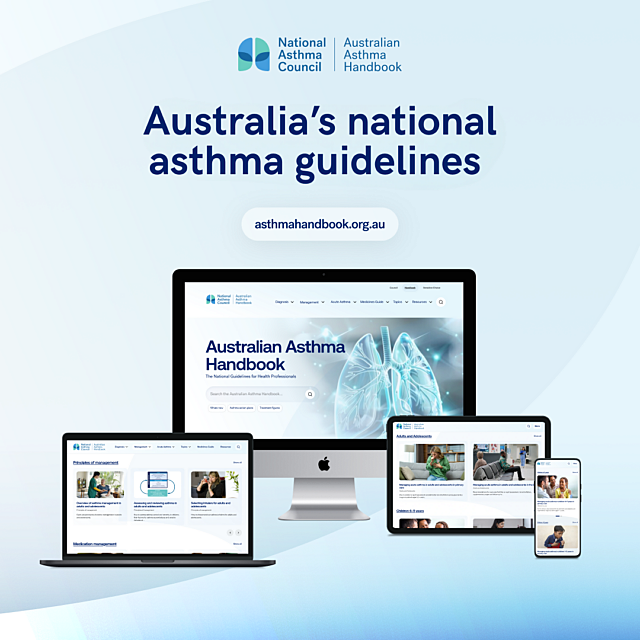
General practitioners (GPs) and other health professionals now have further key resources to help them implement the latest national guidelines from the National Asthma Council Australia’s updated Australian Asthma Handbook.
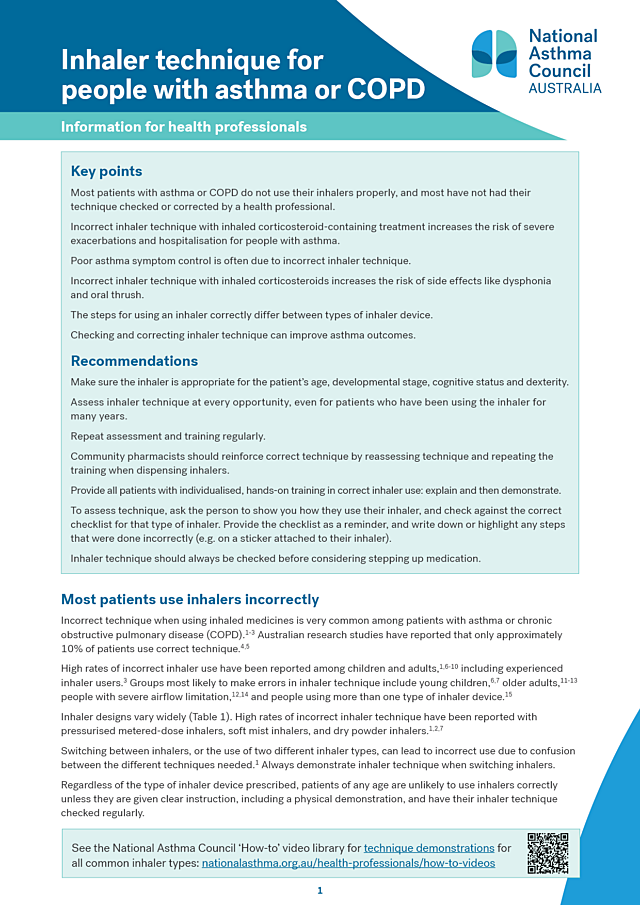
The National Asthma Council today released an updated Quick reference guide (QRG) as well as a comprehensive new Inhaler technique for people with asthma or COPD information paper.
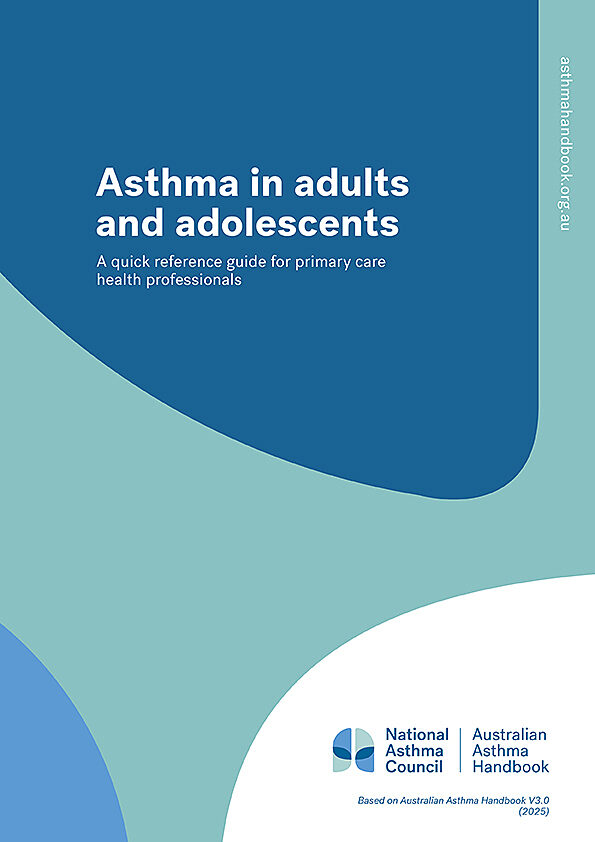
The 20-page QRG provides a summary of key recommendations and information on asthma in adults and adolescents from the National Asthma Council’s Australian Asthma Handbook.
Clinical Associate Professor Debbie Rigby, Clinical Executive Lead National Asthma Council, said with the evolving complexity of asthma guidelines and treatment regimens, it was important to update the QRG resource for primary care health professionals.
“The updated National Asthma Council Australian Asthma Handbook contains significant changes to both the diagnosis and management of asthma.
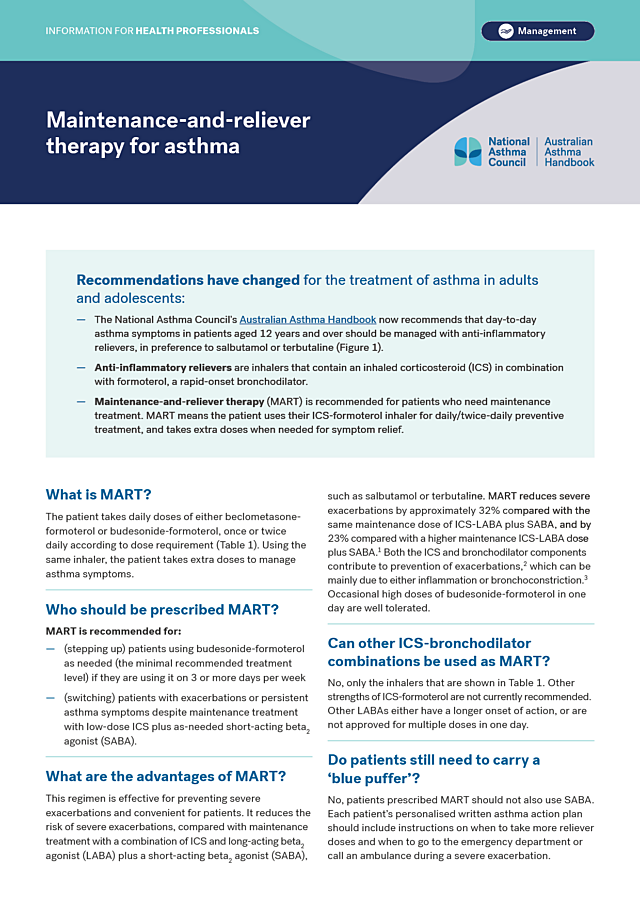
“The QRG provides a concise summary and visuals on the step-by-step control-based approach to asthma management in adults and adolescents. The quick reference tables detail the options and dosing regimens for anti-inflammatory reliever therapy (AIR-only) and maintenance-and-reliever therapy (MART).
“The message from the NAC is clear - the recommendation is to avoid SABA-only treatment and shift towards inhaled corticosteroids (ICS)-containing therapy for all adults and adolescents,” she said.
The QRG is available as a downloadable document, which can be saved on the desktop or printed for quick reference.
Clinical Associate Professor Rigby said the new Inhaler technique for people with asthma or COPD information paper is another vital resource for busy GPs.
“There are a number of new inhalers available, so it’s important to have complete information in one resource.
“It is concerning that most patients with asthma or COPD do not use their inhalers properly, and most have not had their technique checked or corrected by a health professional.
“Evidence shows that inhaler technique improves most when patients are activated rather than simply instructed once or told to read the instructions.
“The inhaler only works if it reaches the lungs properly and even small technique changes can make a big difference to asthma control and prevent flare-ups,” she said.
Clinical Associate Professor Rigby said the most effective way to encourage patients with asthma to practise inhaler technique is to combine repeated demonstration, patient ‘teach-back’ and reinforcement linked to personal benefit.
“Doctors should check inhaler technique at every opportunity, and the PBS requires that inhaler technique is assessed prior to ‘stepping up’ a patient’s medication regimen,” she said.
She added that GPs should try to avoid inhaler polypharmacy and prescribe combination inhalers (dual or triple) when clinically appropriate.
“It is also best to try to stick with the same type of inhaler when patients require multiple types of inhaler, either all pMDIs or all DPIs.
“Showing the National Asthma Council how-to videos together with reviewing the detailed checklist in the information paper will enable better inhaler technique for patients,” she said.
For further information or an interview with a NAC spokesperson, please contact:
Donna Le Page, Le Page PR
Mobile: 0429 825 703 or Email: [email protected]
The National Asthma Council Australia is a collaboration of four member organisations (APNA, ASCIA, PSA and RACGP) and the national trusted authority for asthma knowledge. We set and disseminate the standards for asthma care through our responsive and evidence-based asthma guidelines - the Australian Asthma Handbook and resources for primary health care professionals. Our Sensitive Choice program empowers consumers to identify asthma and allergy-aware products and services.