Our frequently asked questions (FAQs) cover common questions and answers, to help you find information quickly and easily.
I am a:
The National Asthma Council provides education and training for health professionals, including online learning, clinical resources, and guideline-based education aligned with the Australian Asthma Handbook. Training supports best-practice asthma management across primary care and pharmacy settings.
Learn more: Education and training
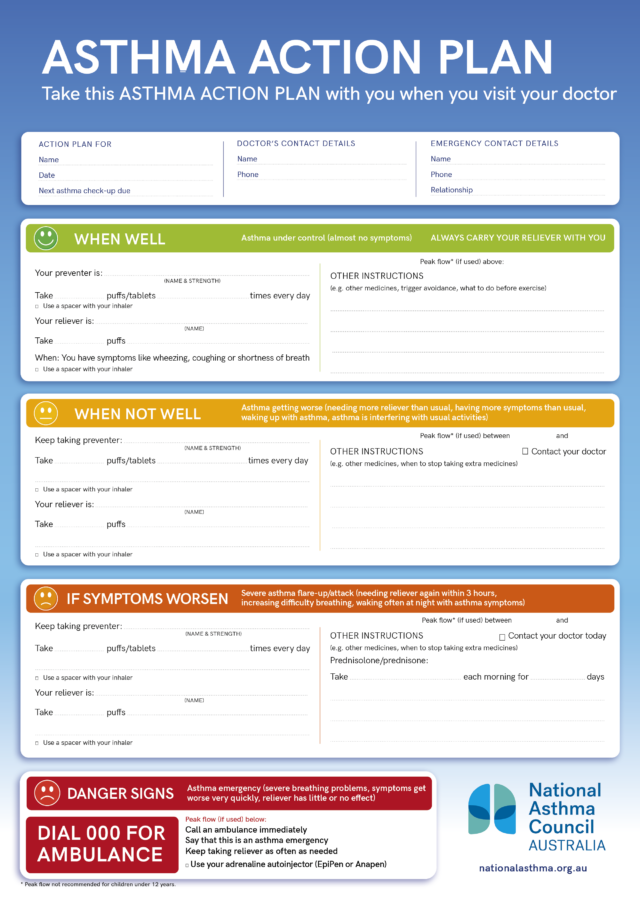
Asthma action plan templates are available at Asthma action plan library.
They can be downloaded and printed from the website, and print copies can also be ordered via the National Asthma Council. Email [email protected].
Asthma action plans should always be completed collaboratively between the patient and their doctor and reviewed regularly.
Many National Asthma Council resources can be downloaded from the website, and selected printed materials can be ordered by completing the online resources order form or by contacting the National Asthma Council directly via email: [email protected].
Please note, a limited range of resource are available for order.
Learn more: Health professional resources
Yes. National Asthma Council resources are copyrighted. Permission is required to reproduce, adapt or distribute materials beyond personal or clinical use. Requests can be made directly through the National Asthma Council.
Email your request to [email protected] and include the name of resource you wish to use, the relevant link (if available), and how you wish to use it. Ensure you attach or link to the resource you wish to use so we can ensure it is the most up to date version.
Unwanted or out-of-date inhalers can be returned to pharmacies through the National Return and Disposal of Unwanted Medicines program, which provides free, safe disposal. If inhalers still contain medication or the canister is not empty, they should always be returned to the pharmacy.
Learn more: Return Unwanted Medicines
Helpful strategies include:
Education and regular review are central to good asthma control.
The spirometry infection control recommendations for primary care were updated by the Thoracic Society of Australia and New Zealand (TSANZ) in March 2026.
Learn more: Spirometry tools & resources
Common comorbid conditions that may affect asthma control or management include allergic rhinitis, chronic rhinosinusitis, gastro-oesophageal reflux disease, mental illness (e.g. depression, anxiety and panic disorders), obesity, obstructive sleep apnoea, and chronic obstructive pulmonary disease (COPD).
The prevalence of comorbidities is high among people with severe asthma.
Over-reliance on SABA increases the risk of asthma exacerbations. Using 12 or more SABA canisters per year is associated with increased risk of death.
The National Asthma Council's updated Australian Asthma Handbook guidelines recommend anti-inflammatory reliever (AIR) only therapy and maintenance-and-reliever therapy (MART) for adults and adolescents aged 12 years and older.
Learn more about the National Asthma Council’s updated asthma guidelines: asthmahandbook.org.au.
The updated National Asthma Council's Australian Asthma Handbook guidelines recommend anti-inflammatory reliever (AIR) only therapy and maintenance-and-reliever therapy (MART) for adults and adolescents aged 12+ years.
Learn more about the National Asthma Council’s updated asthma guidelines: asthmahandbook.org.au.