
Most asthma medicines are inhaled through the mouth using a handheld device called an inhaler.
Most asthma medicines are inhaled through the mouth using a handheld device called an inhaler (or puffer). Correct use of inhalers helps medicines work properly and can reduce the risk of side-effects.
Different types of devices are available. The best choice for an individual depends on the medicines they need and on the person’s age, how well their lungs are working, and which devices they find easiest to use properly.
All adults and children need careful training from a doctor, nurse, asthma educator or pharmacist to use inhaled medicines correctly. Proper use of inhalers helps medicines work properly and can reduce the risk of side-effects. The instructions are different for each type of inhaler device.
Some medicines can be taken directly from the inhaler device, and others should be taken through a spacer (a specially designed container that attaches to a puffer and has its own mouthpiece to breathe through). Using a spacer helps increase the amount of the medicine that reaches the small airways in the lungs, compared with using a puffer on its own.
Most children aged 4 years and over can use a small spacer with a puffer. Babies and young children may need special face mask that attaches to the spacer to inhale asthma medicines.
Face masks must fit tightly around the child’s mouth and nose to make sure none of the medicine leaks out.
Spacers and face masks are available from pharmacies. Your pharmacist can help you choose which type would best suit you or your child and then show you how to use it.
People who take preventers that contain inhaled corticosteroids should rinse their mouth with water and spit after each dose, if possible.
Visit our How-to video library for demonstration videos on a range of inhaler and nasal spray devices.
Download our Inhaler technique checklist.
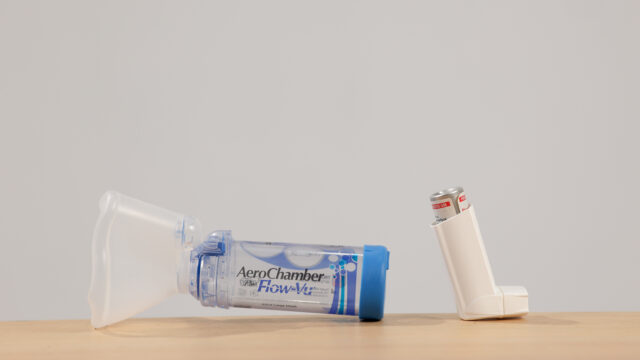
Using salbutamol, a common medication to relieve the symptoms of asthma, with a metered dose inhaler (blue/grey puffer) along with a spacer is just…

Our How-to video library includes demonstrations of correct technique for all the main types of inhalers and nasal sprays.
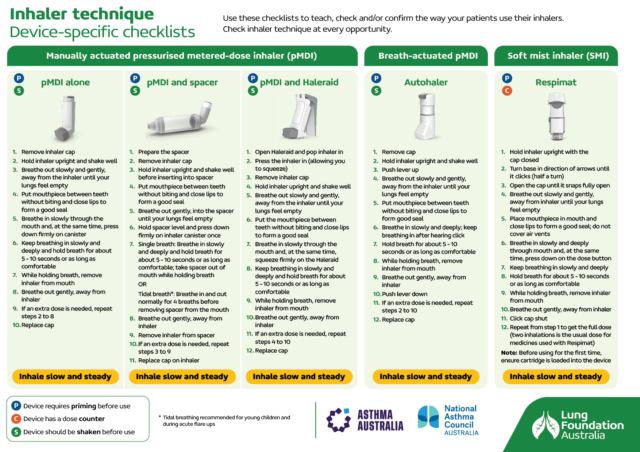
Produced by Lung Foundation Australia in collaboration with the National Asthma Council Australia and Asthma Australia, this handy summary of…
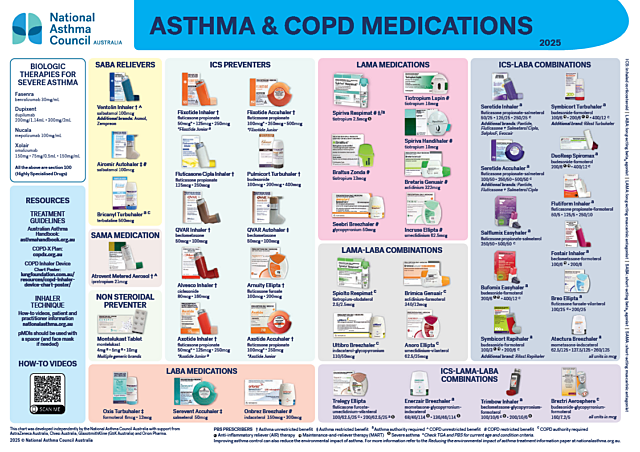
An essential guide to the main types of asthma and COPD medications available in Australia, updated September 2025.
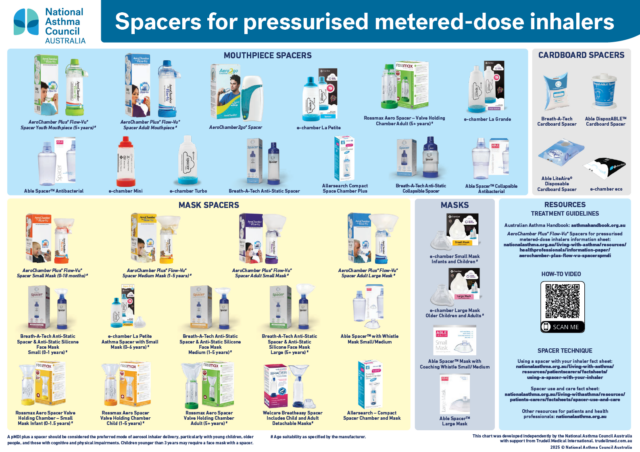
A chart designed to go on the wall of the clinic or pharmacy to help health professionals identify and explain the range of spacers available.
Latest evidence on the prevalence and impact of incorrect technique, plus checklists for using each inhaler correctly.