Article
484 Australians lost their lives in 2025 due to asthma, according to new Australian Bureau of Statistics (ABS) data released today by the National Asthma Council Australia.
Comprised of 315 females and 169 males, the figures are almost identical to the 481 asthma deaths recorded in 2024.
This is the 10th year that the National Asthma Council Australia has released asthma mortality data and the numbers have remained alarmingly high.
Emeritus Professor Amanda Barnard, Board member of the National Asthma Council Australia, said these tragic deaths reinforce that using the whole multidisciplinary team in the approach to managing asthma is critical.
“For clinicians taking a thorough history exploring other possible causes of the symptoms, especially when there are multi-morbidities and undertaking relevant diagnostic tests are all critical to an accurate diagnosis.
“Hand in hand with this is education about the importance of regular treatment, not just relievers when people are symptomatic,” she said.
Professor Barnard said that the updated Australian Asthma Handbook, produced by the National Asthma Council‘s expert guidelines committee and designed for primary care, helps to address this.
“The updated guidelines released last year are clear that all adults and adolescents with diagnosed asthma should receive treatment with an anti-inflammatory inhaled corticosteroid-containing regimen.
“The recommendation is now for anti-inflammatory reliever therapy (with budesonide-formoterol) as needed in those with occasional symptoms. Or maintenance and reliever therapy (inhaled corticosteroid-formoterol), regularly and as needed for symptom control. This provides the best protection for people with asthma against acute attacks,” she said.
Professor Barnard added that as these medications can be combined in the one inhaler, it is much more convenient for patients and ensures that every inhalation works to reduce inflammation.
“The guidelines and the extensive implementation program that is being rolled with all primary care health professionals will help ensure patients understand that treatment of the underlying inflammation can be life saving,” she said.
Professor Barnard said of particular concern in the 2025 findings was the consistently high death rate amongst women, particularly those who are aged over 75 who record 68% of all deaths in women and 44% of total deaths.
“This a complex and multi factorial issue. One of the factors is that people over 75 often have comorbid conditions including heart disease, diabetes, arthritis, reflux or obesity. Not only may these complicate diagnosis and management, but patients may not prioritise their asthma, especially if they do not have regular symptoms.
“When talking with older patients with comorbidities and asthma, it is critical to reinforce that even if they are not symptomatic all the time with their asthma, it is important to treat it and recognise that acute severe and life-threatening attacks of asthma can occur even in patients who may may have so-called mild asthma,” she said.
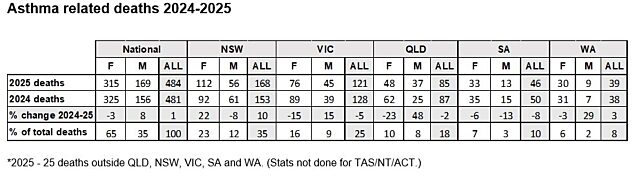
View 2025 mortality infographic.
For further information or an interview with a NAC spokesperson, please contact:
Donna Le Page, Le Page PR
Mobile: 0429 825 703 or Email: [email protected]
The National Asthma Council Australia is a collaboration of four member organisations (APNA, ASCIA, PSA and RACGP) and the national trusted authority for asthma knowledge. We set and disseminate the standards for asthma care through our responsive and evidence-based asthma guidelines - the Australian Asthma Handbook and resources for primary health care professionals. Our Sensitive Choice program empowers consumers to identify asthma and allergy-aware products and services.